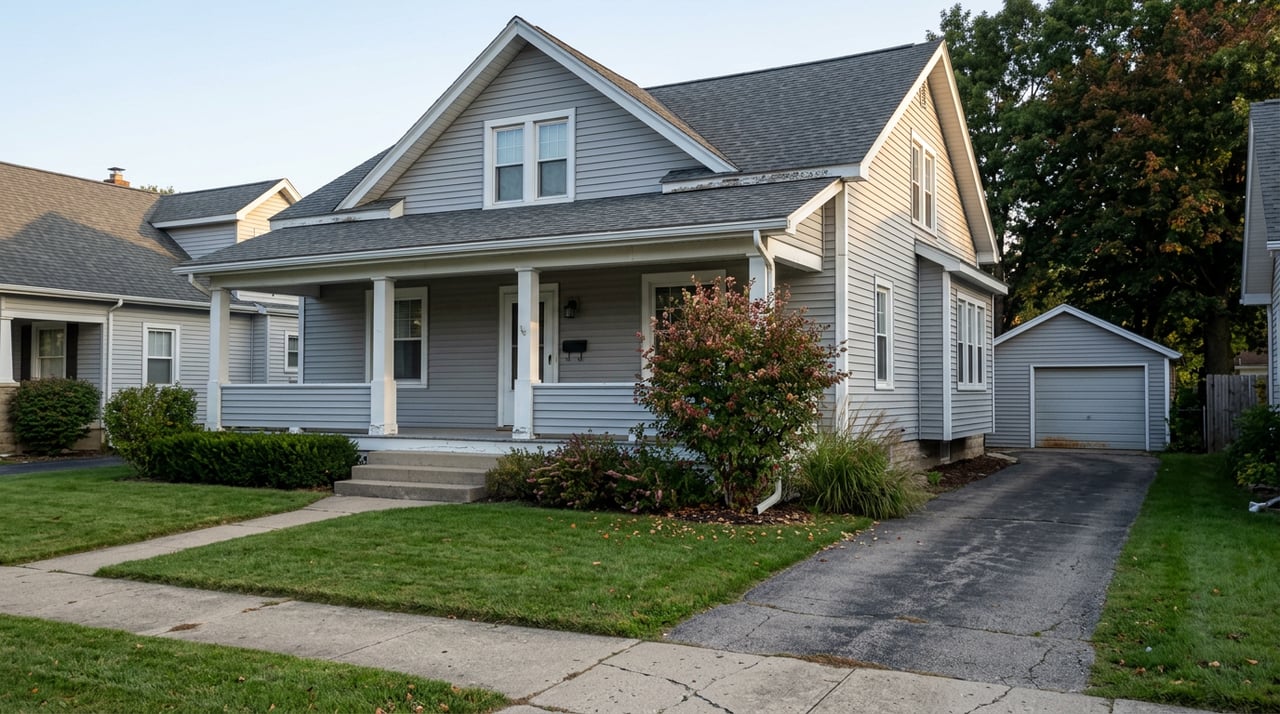
Hopewell Township PA Real Estate and the Price Gap
September 10, 2026
September 10, 2026
Say you're moving from a house in Moon Township into one just across the line in Hopewell Township. The townships share a border, but that alone doesn't mean every address is the same distance from Pittsburgh International Airport or downtown Pittsburgh. You've done the math on the sale price and it looks like a clean discount, maybe tens of thousands of dollars for a comparable lot. Then the first full tax bill arrives and it doesn't scale the way the sale price did. That's not a fluke in the paperwork. Crossing into Beaver County means a different mix of tax rates and an assessed-value system that has nothing to do with how close your driveway sits to the runway.
That gap between what a house costs and what it's taxed on is the actual story here, more than any simple "it's cheaper across the border" headline. Buyers treat Hopewell Township as a discount version of Moon. It isn't. It's a separate fiscal jurisdiction that happens to share a fence line, and the discount and the tax structure are two sides of the same mechanism.
Hopewell Township covers about 17 square miles along the southeastern edge of Beaver County, with roughly 16.8 square miles of that being land. It wraps around three sides of the city of Aliquippa, shares that city's zip code, and touches South Heights to the southeast. On its other flank, it borders Crescent Township and Moon Township, both in Allegheny County. That's the part worth sitting with: Hopewell isn't near the airport corridor the way a distant commuter town is near something. It physically touches Moon Township.
Nothing about the land changes at that border. The roads don't change grade, the tree line doesn't shift, the terminal remains where it is. What changes is which county, township, and school-district tax rates apply, which school district enrolls your kids. That's the entire difference, and it's enough to move the price tag substantially.
Public estimates for Hopewell Township's home values cluster in a fairly tight band, though they vary by source and shouldn't be read as exact figures. One aggregator puts the median around $179,000. Another puts it closer to $192,000. Neither is an MLS-verified figure, but they agree on the general range, and that range sits well under what Beaver County as a whole was doing as of March 2026, when the county's median sale price came in at $220,000, up 7.3% year over year, with homes averaging 84 days on market compared to 67 days the year before.
That's the detail that sharpens the puzzle. Hopewell isn't just priced below its Allegheny County neighbors. Based on the available estimates, it appears to be priced below Beaver County's own recent median too. If the gap were purely about distance from Pittsburgh, you'd expect Hopewell to track closer to the county average, since it sits on the county's most urban edge, not its far end. Something more specific than geography is holding the number down.
Hopewell Township publishes its own tax rate breakdown, and it's a useful place to look for that something specific.
| Taxing body | Millage |
|---|---|
| Hopewell Township | 16.00 mills |
| Beaver County | 2.36 mills |
| Local school district | 11.99 mills |
| Combined | 30.35 mills |
A mill is a dollar of tax per thousand dollars of assessed value, and that word "assessed" is where the friction actually lives.
The other half of the tax story is what the mill rate is paying for. Along Route 60, the township's own planning materials show the majority of available land still zoned Residential-Agricultural. There's no built-out commercial corridor absorbing part of that 30.35-mill load the way a retail district does in some neighboring Allegheny County suburbs. The tax base here is still mostly homeowners, which is part of why the rate is stacked the way it is.
Here's the piece that changes the outlook, at least for anyone thinking past the next few years. A Carnegie Mellon University analysis of southwestern Pennsylvania identified Hopewell Township as one of four sites positioned to anchor an "aerotropolis," a development model built around airports as the center of urban growth rather than the edge of it, with Hopewell playing a significant role given its position at what the township calls the gateway to Beaver County.
The township has already had one piece of that infrastructure in place since 1987, when it established a 97.5-acre RIDC industrial park. Some of that same footprint is still listed as open today: the township's current planning inventory includes a 97.5-acre industrial-zoned parcel on Laurel Road among eight undeveloped industrial sites still available along the corridor, alongside a 46-acre special growth district site, a 13.9-acre special growth district site, a 107-acre parcel zoned Industrial Park, a 10-acre Industrial District site, a riverfront industrial parcel, and land in the township's Commerce Way Phase III. Separately, the Route 60 corridor itself lists 26 more properties available for development, most still zoned Residential-Agricultural.
None of that land is built out yet. But it's the flip side of the tax-base problem described above. If any real share of that acreage converts from farmland-zoned holding parcels into actual industrial or commercial tax base, the math behind that 30.35-mill stack starts to shift, because the burden stops falling almost entirely on residential owners. That's a slower story than a single season of home sales, but it's the one that explains why land brokers and investors watch this corridor differently than they watch a fully built-out suburb.
Buyers comparing Hopewell to Moon or Wexford should also know that Hopewell Area School District doesn't map exactly to Hopewell Township's own boundary. The district serves Hopewell Township along with Independence Township and Raccoon Township, running six facilities in total, including Hopewell Senior High School, Hopewell Memorial Junior High School, and Hopewell Elementary School, all in the Aliquippa area. That 11.99-mill school levy inside the combined rate above funds that whole three-township district, not just Hopewell's slice of it.
The lower price tag in Hopewell Township is real, and for a buyer prioritizing square footage or lot size over proximity to Allegheny County's commercial corridors, it can be a legitimate trade worth making. What it isn't is a free discount on a commute you can assume is identical to Moon's. It's a different fiscal system attached to the same geography, and the two things that matter most before writing an offer are the parcel's actual assessed value, which only the county assessment office can confirm, and whether you're comparing apples to apples on school district boundaries, since Hopewell Area doesn't stop at the township line either.
For investors, the Route 60 corridor and the existing RIDC park are worth tracking separately from the residential market. Land carrying an Aerotropolis designation and sitting this close to Pittsburgh International Airport doesn't often stay priced like undeveloped farmland forever, even if the timeline for that to change is measured in years rather than months.
Is Hopewell Township's lower price simply a function of being farther from Pittsburgh? Hopewell physically borders Moon Township, but that shared border alone does not establish that distance from the city isn't a factor. The gap tracks more closely with the different county tax structure and assessed-value system than with commute distance.
Does bordering Moon Township mean Hopewell shares its zip code or services? No. Hopewell Township surrounds the city of Aliquippa on three sides and shares Aliquippa's zip code, not Moon's. Emergency services, school enrollment, and municipal billing all run through Beaver County and Hopewell's own township government.
Is the land along Route 60 zoned for commercial use right now? Mostly not yet. The bulk of the parcels listed as available along that corridor are zoned Residential-Agricultural, with only a handful of specific tracts currently zoned for industrial use. That possibility is worth watching rather than assuming.
If you're weighing a move across that county line, or you're an investor trying to figure out what a Route 60 parcel is actually worth before it gets rezoned, the LaRocca Real Estate Team works this exact stretch of western Pittsburgh's suburbs every week. Reach out for a complimentary home valuation and a straight answer on what a specific parcel's assessed value and tax picture actually look like before you write an offer.
This article is general information, not legal, tax or financial advice. Consult a qualified professional about your situation.
Stay up to date on the latest real estate trends.
Whether you're looking to buy, sell, or just want to chat about the exciting world of Pennsylvania real estate, let's start a conversation. Reach out to us today, and let's connect to explore the possibilities.